Being Kind vs Being Available: How to Tell Them Apart
For a long time I thought my kindness was the thing wrong with me.
I thought it was the reason people helped themselves to my time, my money and my patience. If I ever wanted that to stop, I'd have to become someone harder. I really did not want to be that person. So I stayed exactly as I was, and it kept happening.
Have you ever caught yourself thinking "I'm just too nice"? Maybe somebody has even said it to you with a smile, as if it were a diagnosis. I still catch the thought sneaking back in on a bad day.
Being too nice and being just too available can feel like the same thing from the inside. Once you can tell them apart, you get to keep the kind bit. To be honest, it took me an embarrassingly long time to see it!
The thing people were helping themselves to
Here's what I eventually worked out. The thing people were helping themselves to was my availability.
Two very different things had got welded together in my head. One is who I am. The other is a habit I picked up. And because they'd been stuck together for so long, every time I tried to protect myself from the habit, it felt like I was attacking the kindness.
Your kindness stays yours whatever anyone does with it. The noticing, the remembering, the way you make a room feel welcome, all of that stays put.
Your availability is a different creature. People can help themselves to that. They keep coming back for the simplest reason in the world: you've always been there, like a shop that never shuts. That's why people keep asking, and why becoming "less nice" would never have fixed it.
Why they came in the same lesson
I think most of us niceaholics learnt them in the same lesson. Being kind got us liked. Being available got us thanked.
If you grew up watching faces, you'll know what I mean. From the outside, the child who notices what everyone needs and the child who is always there to provide it look like the same child. They're two different skills. One of them is lovely, and the other one is costing you.
(I wrote about the years I spent believing niceness itself was the problem in Being Nice Gets You Nowhere. I had it backwards then, too.)
Pull them apart on paper
This is the exercise that finally did it for me, and it takes ten minutes.
Take a page and draw a line down the middle.
Left: kind
Write what's kind about you. The noticing, the remembering, the way you make people feel welcome, the card that arrives on the right day.Right: available
Write what's available about you. The yes before you've checked, the phone answered at any hour, the favour nobody asked for. The message answered within four minutes, because leaving it even an hour felt rude.Now look at the two columns. Which one would you miss if it changed?
I've never met anyone who wanted to shrink the left-hand column. It's always the right-hand column. Once you can see it on its own, it starts to look like a habit. And a habit is a much easier thing to change than who you are, right?
Your answer is information
For years I treated my own answer as an opening bid, something to be talked down from. "I can't this weekend" meant "make me a better offer."
When I started treating it as plain information, the way I'd treat "it's raining", the negotiating mostly stopped. There was nothing left to negotiate with. Kind people say no all the time. They say it with something warm attached, and then they stick to it.
What to say when you can't be there
One or two lines will do it. Each one keeps the kindness in and the availability out, and none of them needs you to become harder. Try these:
Every one of them is kind. Each one says what you can't do and wishes them well, so you can say it without feeling mean, and they still know you care.
A favour at 9pm on a Tuesday
- A friend messages at 9pm: "Can you just have a quick look over this application for me? Need it in by nine tomorrow." The old you is already opening the attachment before you've even decided. Now you're up until eleven with someone else's application, and running on empty at work the next day.
- The new you feels the same pull to open it straight away. This time you notice what she's asking for: your evening, at 9pm. Your kindness can stay exactly where it is. So you reply: "I'd love to help and I can't tonight. Good luck with it, and send me the next one a few days earlier so I can look properly." Then you put the phone down.
- A few minutes later she writes back "ok, no worries". You feel a wobble of guilt for ten minutes or so. Then you pick up your book, and the evening is still yours.
I'm every bit as kind as I ever was
I'm every bit as kind as I ever was. I've simply stopped being available to be walked over. That's a very different fix from becoming cold (which I would have been miserable at, and so would you!).
What changed is that I stopped treating other people's comfort as my responsibility, and I started treating my own answer as information. Mostly, it was my time with my daughter I'd been giving away, to catch up with people and help. She was growing up fast, and that's what opened my eyes. (I wrote that whole story in This Is How I Learned to Say No.)
Try this
Write this sentence in your phone notes, so it's there the next time you catch yourself thinking "I'm too nice":
Then do the two columns. Ten minutes, one page. Circle the one thing on the available side you'd most like to be rid of. Pick a line from above and use it for real on the next small ask, the kind where a no costs you nothing.
The worries I hear most about this one
Will people think I've changed? That's such a common worry, and it's usually much smaller than it feels. Some will notice you reply more slowly and say no a bit more, and most people adjust. Some may drift once you're less available, and I know that stings. Give it a few weeks before you decide what it means.
Isn't being available part of being a good friend? Of course, being there when it matters is. Being there at any hour for any ask is a habit, and it can leave you running on empty.
What if I love helping? Then keep helping! Help once you've checked you can, so the help stays kind and you don't end up resenting it. The columns let you keep the helping you love and stop the helping you only do out of habit.
Tell me how you go
What did you circle on the right-hand side? I really love hearing how you went.
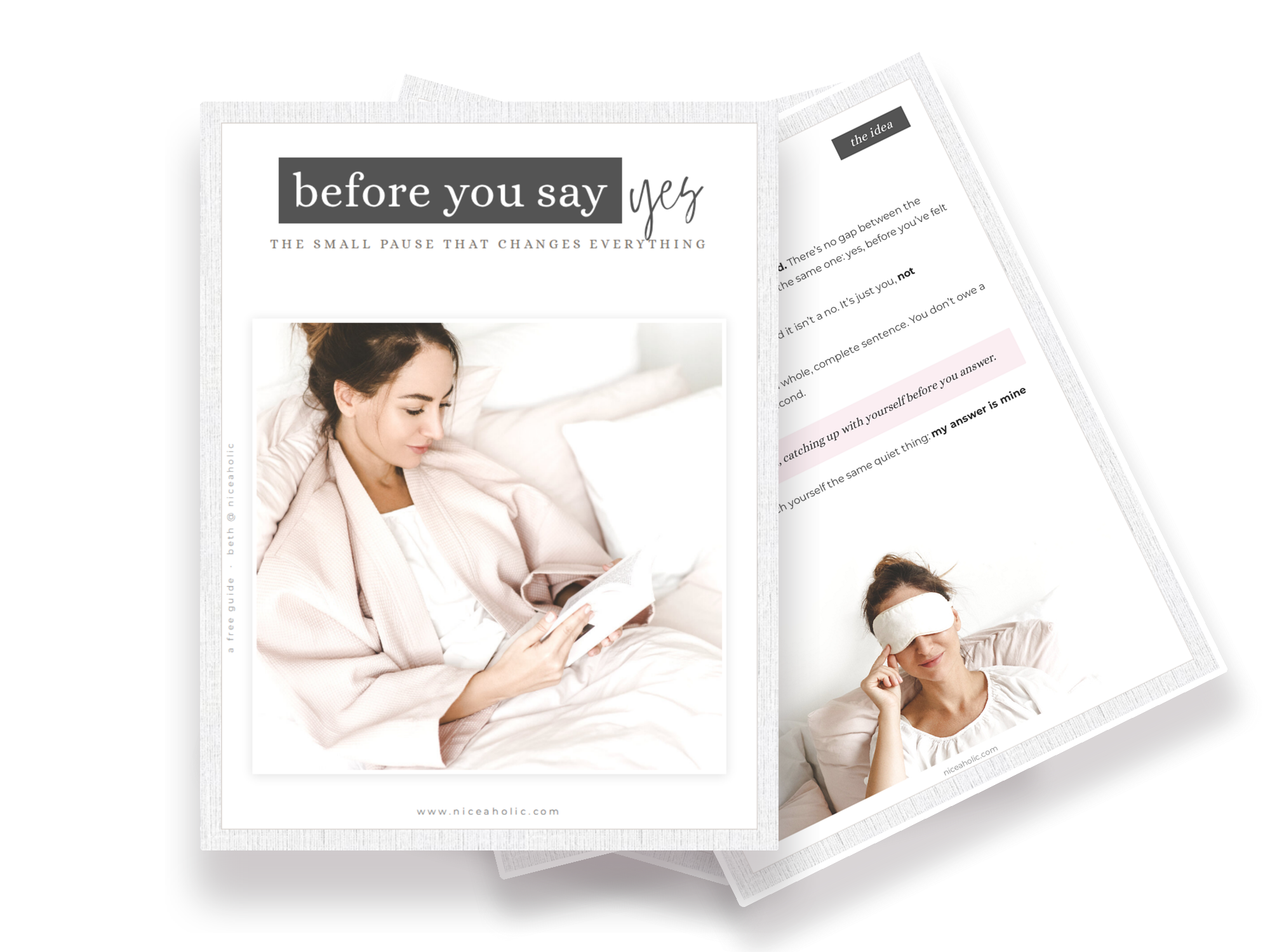
Want a moment to check before your evening goes to someone else's favour?
My free guide, Before You Say Yes, is a short guide to pausing before you answer, with lines to keep. You stay kind, and you get to look at your week first.
Send me the free guideFree. Arrives by email.And the next time someone calls you too nice, you can smile and stand a little taller. You're every bit as kind as you were, and your evenings are your own again.
This is general information, not therapy. If you're ever frightened for your safety, please contact your local emergency services.