Why You Say Yes Before You’ve Decided (and How to Pause)

Someone asks you for something. Before you've even thought about it, "yes, of course!" is out of your mouth. Then you spend the rest of the day (sometimes the rest of the week) working out how on earth you're going to fit it in.
Does that sound familiar? I still catch myself doing it, and I've been at this a long time.
For years I treated that quick yes as a willpower problem, and I suspect you might too. So I want to show you why it happens, and give you the one line that buys you a three-second pause. Once you can see it, the fix is much smaller and much kinder than "just be stronger".
You never actually decided anything
Have a look at the moment again, slowly. Somebody asked. You answered. In between, there wasn't even a second to check the calendar or ask yourself whether you wanted to.
If you had decided, you could decide differently next time. But you never got to make a decision at all. The autopilot made it for you, in about half a second. So what you need is a few seconds of space before you answer. That's a much easier thing to build than a whole new personality. Don't you think?
Where the quick yes came from
Here's what I think is going on underneath, because understanding it helped me enormously.
Somewhere early on, most of us niceaholics worked out that a quick yes keeps everyone comfortable, and that any hesitation at all feels like the start of trouble. If you grew up in a house where someone's mood set the weather, that was a very clever thing to learn. A child who says yes fast is a child who stays safe.
So please don't be cross with yourself for it. The quick yes was a good idea once, and it worked, which is exactly why it stuck.
The trouble is that the habit kept running long after you needed it. Now you answer before you've had a chance to check what you think. You read the room for danger, see someone waiting, and hand over the answer that has always kept the peace.
You give the fast one so often that the second one never gets a look in.
(If you'd like the longer version of where this comes from, I wrote about it in What Causes People Pleasing.)
You already have the willpower
So many of us have been told we need to try harder. Look at what you already do with your willpower, every single day:
- You show up when you're tired.
- You finish the favour.
- You host the thing.
If willpower were the problem, you'd be the last person on earth with a people-pleasing habit!
What you need is much smaller: the three seconds it takes to find out what you think. Give yourself those three seconds, and you'll usually know what you want to do.
Make the pause about logistics
A pause on its own is hard for us. Even a few seconds of silence can feel like trouble, and "let me think about it" sounds, to our own ears, like the start of a no. So we panic and fill the silence, and the yes falls out.
Try making the pause about logistics instead, and leave the decision out of it for now.
Nobody argues with logistics. "Let me check the calendar and come back to you tonight" sounds organised, and it buys you hours. It also says nothing about what your answer will be. You've said "I'll look", and that's all you've said. Nothing has been decided yet.
That's the trick, and to be honest I'm a little embarrassed by how long it took me to figure this out!
Three lines that buy you the pause
The words go missing when a real person is standing in front of you, so it helps to have them ready before you need them. Pick whichever sounds most like you:
None of these is a no, which is why they work. For the person saying it, each one feels safer than a plain no, and you get the pause you need to actually think about it properly.
"I want to say yes" is often true! You do want to help. You'd like to help once you've checked that Saturday is still yours, so that when you say yes, you really mean it.
The part people skip: actually come back
This is the bit I skipped for years, and it's the bit that matters most. How many times had I said "I'll let you know" and then simply never let anyone know? Far too many. And it wasn't because I didn't care. I was just too scared to have the conversation, because I didn't know what to say.
So say when you'll answer, and then do it. If you said tonight, answer tonight. If you said the morning, text in the morning.
If the scary part is not knowing what to say when you come back, keep it short. You don't need a speech:
Coming back is what stops the pause turning into avoiding them. A pause with a promise attached is you buying a little time, like a grown-up, right? A pause with no return leaves the other person waiting, and that ends up being the very rudeness we were turning ourselves inside out to avoid.
And when you do come back, you'll have had time to decide what you actually want to do. Sometimes the answer will still be yes, and that's lovely, because now you really mean it, and they'll be able to tell.
What to do when they push
Sometimes the person doesn't want to wait. "Oh, just tell me now, it's only a small thing."
You can use the same line again:
You'd be surprised how easily most people accept that. If someone keeps asking, say it a third time, word for word. You don't have to work out why they're pushing, and you don't have to explain yourself. You only have to stand your ground and not cave.
Your sister, a Saturday, and a pause
- Your sister rings on Wednesday. Can you have the kids on Saturday, just for the afternoon? The old you has said "of course!" before she's finished the sentence, and is now quietly moving around three things you were really looking forward to.
- The new you says, "I'd love to help, let me just check what's on and I'll text you tonight." Nobody has been let down. Nobody has been told no. You've bought yourself the afternoon to find out what you think.
- Then, tonight, you look. Maybe Saturday is fine, and you text "yes, drop them round at one", and you mean it, so you're glad to see them. Or maybe Saturday was the one afternoon you had to yourself this month. Then you text, "I can't this Saturday, sorry, but I could do Sunday morning if that helps." Either way, the answer came from you, and both of you know it.
Try it this week
Pick one of the three lines and type it into the notes on your phone, so it's there before you need it. It might feel a bit silly, and that's ok 🙂 The first time you use it for real is a terrible time to be hunting for the words.
Then use it once, on something small. A coffee invitation, or a favour that wouldn't have hurt much either way. Practise it when the stakes are tiny, so it's there for you when they're not.
And afterwards, write down what happened. Did they mind? In my experience they almost never do, and your memory of it will be harsher than the real thing.
A few things you might be wondering
What if I've already said yes? Then you've said yes, and you can still take the pause after the fact. "I said yes too quickly, and I've had a look at my week. I'm not going to be able to do it, sorry." It feels enormous, and it's one text.
Doesn't asking for time make me look unreliable? The opposite, in my experience. People trust a yes far more when they've seen you say "let me check" first, because they know that when you say yes, you mean it.
What if the answer really is yes? Then say yes, and enjoy it! The pause is there so that every yes you give is one you really mean, and a yes like that is a lovely thing to give someone.
My own story of learning to say no is in This Is How I Learned to Say No.
Tell me how you go
Which of the three lines did you try first, and what happened? I really love hearing how you went.
Keep the pause in your pocket
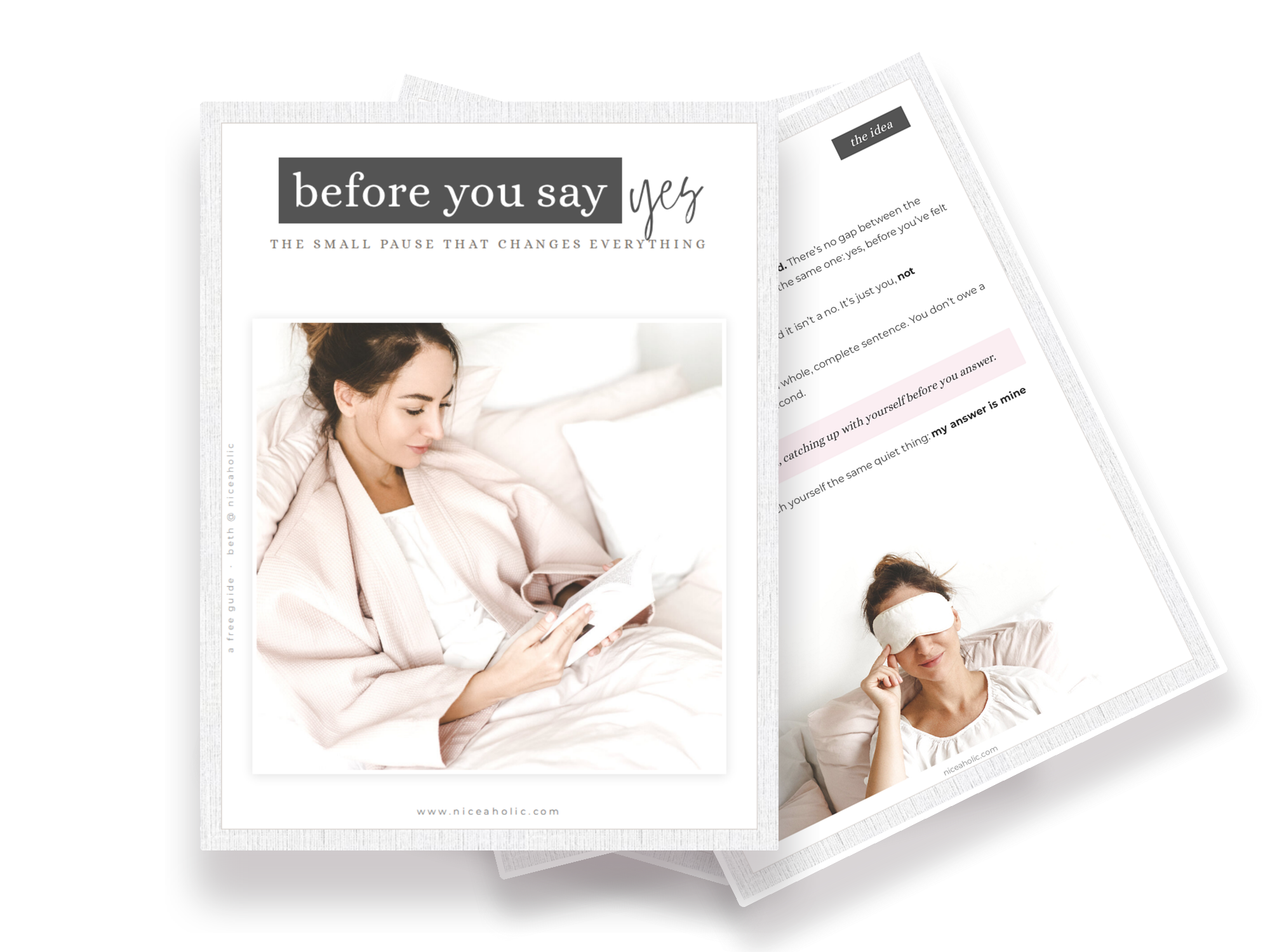
My free guide, Before You Say Yes, is a short read on pausing before you answer. The lines to keep are in there too, ready for the next time someone asks.
Send me the free guideFree. Arrives by email.Picture the next time your phone rings with a favour. You hear yourself say "let me check and I'll text you tonight". You breathe out, your shoulders drop, and you feel safe and calm. And what happens next is totally up to you.

This is general information, not therapy. If you're ever frightened for your safety, please contact your local emergency services.