Why You Go Blank When Put on the Spot (and What to Say)

In the shower you can think of nine ways to handle it. On the drive home you can write a beautiful message in your head, every word in the right place.
Then a real person stands in front of you and waits, and every word you had is gone. The words come back at about 11pm, when they're no use to anyone. Has that happened to you?
Going blank happens to kind, clever people all the time, and there's a reason for it. Here's why it happens, and what to say when you're put on the spot: a line to have ready for when you go blank.
Why you go blank when someone is waiting
This is what I think is going on, and seeing it is what let me stop being so hard on myself about it.
Going blank is your body being triggered by a small threat. Someone is waiting, and they might be disappointed in you. And when you're braced for a reaction like that, it's very hard to find words at all.
Most of us learnt to watch faces before we learnt to say what we wanted, and we still watch first. So when someone falls into step beside you at the school gate or in the work corridor with a "can you just...", you go quiet while you work out what they need from you.
Quite often, going blank is part of you holding back a yes you haven't checked. You don't want to agree yet, but you haven't got anything else to say. So you say nothing.
Why you can't think your way out of it
I spent years trying to be quicker and cleverer, with a better answer ready for every possible ask.
It never worked, and now I know why. When you're braced like that, you can't think clearly, so hunting for the perfect words in the moment only stretches the silence. The silence stretches, you panic, and you say yes to end it. There goes another evening.
You know you'll find the perfect words later in the shower, hours too late. So please stop hunting for them in the moment, and have something ready that needs no thinking at all.

Two lines that don't need thinking about
You're better off with an ordinary answer you already know than a clever one you haven't found yet. These two cover almost everything:
They're ordinary on purpose. When you've gone blank, you can only reach for something short that you've seen many times before. A clever line disappears along with all your other good sentences.
(If the second one sounds familiar, it's the same pause I wrote about in why you say yes before you've decided.)
And one for when the blank has well and truly landed
This one is my favourite, and to be honest it took me the longest to be brave enough to use!
Saying what's happening is often the strongest thing you can say. It buys you the second you needed, it's completely true, and nobody has ever minded it. Most people laugh a little and wait, because it's happened to them too, right?
Say it slowly
When we go blank we rush, and rushing is how a no turns into a maybe.
So say your line at half the speed you want to. It will feel painfully slow to you and perfectly normal to them. Going slowly lets the other person hear a finished sentence. It also gives you time to stop at the end of it and stand your ground, before you tack a "but I suppose I could" onto the back.
A Thursday corridor, with a line ready
- It's Thursday, you're walking back from the printer, and a colleague falls into step beside you. "Oh good, I was hoping to catch you. Can you just take my Friday afternoon meeting? I've got a thing." The old you goes blank for a horrible second and then hears herself say "yeah, sure, no worries", and spends the walk back to her desk wondering how on earth she just gave away her Friday afternoon.
- The new you feels herself go blank and says the ready line, slowly. "I need to think about it. I'll let you know by lunch." Your colleague says "great, thanks" and heads off.
- Then, at your desk, you look at Friday. Maybe you can, and you send "yes, I can take it", and you mean it. Or maybe Friday afternoon was the only quiet stretch on your calendar. Then you send, "I can't take that one, sorry, I've got something I can't move." Either way, you made the decision at your desk, with your calendar open.
Keep the 11pm words
When the words arrive late, and they will, write them down anyway. They're the draft for next time, and next time comes round sooner than we'd like. I keep mine in my phone, in a note that has quietly become the most useful thing I own. Half of what's in my Boundary Scripts started life at 11pm.
Get one line ready this week
Choose one of the lines above and text it to yourself, word for word. It sits at the top of your messages, so you'll see it every time you open them this week, until it looks like something you'd say. You want to have seen it plenty of times before your brain has left the building.
Then use it once, on something small, where the stakes are low, so it's there for you when they aren't. For example:
- a "can you just" at work
- a neighbour who wants a favour
- a friend who wants an answer on the spot
And afterwards, write down what you said and what they said back. In my experience they almost never mind. Then write down what you wished you'd said, and keep it for next time.
Three things you might be wondering
What if I go blank and say yes anyway? Then you've said yes, and you can still take the second you needed once you've walked away. "I said yes on the spot and I should have checked first. I'm not going to be able to, sorry." One text, and it counts.
Won't "I need to think about it" sound like a no? It can, to some people. So add a time ("I'll let you know by lunch") and then answer by lunch. They know an answer is coming, and if it's yes, it's a yes you really mean.
Does the blank ever stop happening? It does get rarer, I promise. Mine did, and I think it's because I stopped needing the perfect sentence. Once you know an ordinary one will do, there's so much less pressure on you in the moment, and a lot less to go blank about.
Tell me how you go
Which line did you use, and where were you when the blank hit? I really love hearing how you went.
Have your lines ready before anyone is waiting
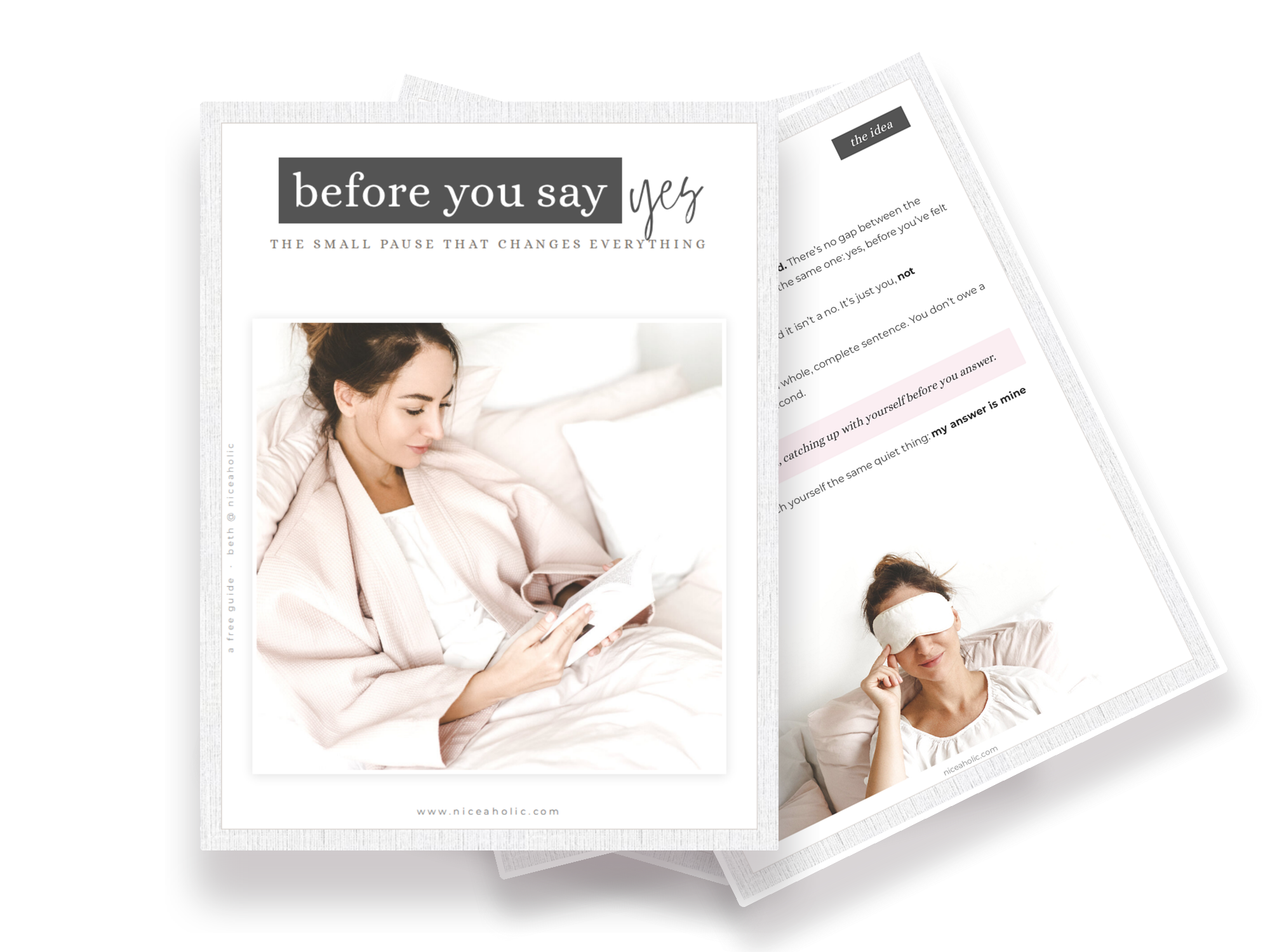
My free guide, Before You Say Yes, is a short read on pausing before you answer, with the lines already written. You'll never be hunting for them with someone standing in front of you.
Send me the free guideFree. Arrives by email.The next time someone falls into step beside you with a "can you just", your line will be there before you blank out. Your voice is clear and strong, you say it slowly, and you haven't given away your precious Friday afternoon.
This is general information, not therapy. If you're ever frightened for your safety, please contact your local emergency services.