
How to Stop Over-Explaining When You Say No (One Line)

You say no. Then you explain why. Then you explain a bit more, because the first explanation didn't seem to land properly.
By the fourth sentence you've handed over a whole list of reasons, and every one of them is now something the other person can argue with.
Sound familiar? I'll be honest: I have sent text messages four paragraphs long to explain a no that needed one line, and the second paragraph still tempts me!
Here's how to say no and stop explaining: one line, a full stop, then count to three. For most of us niceaholics, the no itself usually goes fine. The trouble starts in the sixty seconds after it, when we give it all away.
A reason is an invitation
A reason, however good, is an invitation to keep talking. The moment you give one, the two of you start talking about whether your reason is good enough. And you lose that one every time, because you're the only person in the conversation grading your own reasons harshly!
Here's what happens when you give a reason. "I'm too tired" gets "oh, it'll be a quick one." "I've got no money this month" gets "I'll shout you." Your answer hasn't changed one bit. But now you're defending your reason, when a minute ago you were standing beside your decision.
A reason
Give a reason, and you've asked the other person to solve something.A decision
Give a decision, and you've asked them to accept something.When you hand over a reason, you've turned your no into a puzzle, and kind, capable people love a puzzle, right? Of course they start solving it. You gave it to them.
The reason gets longer the less sure you feel
The over-explaining comes from a good place. You're trying to prove you aren't being unkind, because being thought unkind is what you're afraid of.
A lot of us grew up where a bare no wasn't allowed. A good enough reason might get us through, so we got very good at reasons. The less sure you feel, the more of them you produce. That's why the text keeps growing after you've pressed send in your head.
You're using reasons for an old job: making sure nobody could think badly of you. From here, you'll do that job with one sentence.
A decision only needs saying
That's hard for us, I know. It feels rude to leave a no sitting there by itself. But a decision can stand by itself. The person you're talking to needs a clear answer, a warm voice and a moment to adjust. They only get that moment if you stop talking.
(If you like a quote to keep you company on this one, I put my favourites together in Stop Explaining Yourself.)
Three lines that end at the full stop
These three do the job on their own, and each one stops at the full stop:
Stopping at the full stop tells them the decision is finished. You haven't criticised them or their request, so there's nothing for them to defend. Say one, then close your mouth.
Count to three after the full stop
Three seconds of quiet will feel like a very long time. That's the old habit, and it passes faster than you'd think.
Here's what's happening in those three seconds. Your body is being triggered by the quiet, because growing up, any quiet at all could mean someone was upset and something was coming. Filling it was how you got ahead of that. On their side, it's usually far less dramatic. Most people need a moment to adjust when an answer wasn't the one they expected.
If you fill the silence, you take that moment away from them and hand them your wobble. Once they hear a wobble, most people push a little, to see if the no will move.
The other person, by the way, usually says "ok, no worries." All that worry about saying no, and the reply is two words. I have made myself sick about this, and they say ok! (I tell that whole story in This Is How I Learned to Say No.)
If you must give a reason, give one
Sometimes a reason is kind and right, especially with people you love. So give one, make it true, and stop there.
One true reason is enough for anyone who cares about you. A second one usually comes from nerves, and it gives them something to bargain with. If you notice yourself reaching for the second one, that's your cue that the full stop was due a sentence ago.
A bake sale in the group chat
- The class group chat lights up on Sunday night. "Can anyone do the bake sale this Saturday? Beth?" (Fine, it's always you.) The old you types: "Oh I'd love to but Saturday is really tricky, we've got Mum's thing in the morning and I think Ella has a swimming lesson, although I could maybe move that, let me see, I'm so sorry, I feel awful..." Four paragraphs. And somebody replies "All good! Could you do the morning shift then?", because you handed them three things to work around, and they worked around them. Now you're doing the morning shift you were trying to get out of.
- The new you types: "I can't this Saturday, sorry! Hope it goes really well." Full stop. Then you put the phone face down and count to three, which in group-chat time is roughly forever.
- What comes back is "No worries, thanks Beth x", and somebody else's name goes on the roster. Nobody calls you unkind. They didn't get a puzzle, so there was nothing to solve.
Try this
The counting is the bit everyone skips, so start on paper. Pick one of the three lines and write it in your phone notes, with "count to three" underneath. The counting will feel odd (it did for me, for weeks), and that's ok. Each time you do it, you learn what a silence feels like when nothing bad happens in it.
Then use it for real, once, on something small. Pick a "can you just" that you'd normally explain your way out of. Say your line, stop at the full stop, count to three, and see what they say back.
Afterwards, write down how many sentences you needed, and what they said. I'd bet it was shorter and kinder than the conversation you'd run in your head. Read those notes back after a few weeks, and you'll see the full stop was enough.
Before you go
What if they ask why? You don't have to have a perfect answer ready. Sometimes "why" is real curiosity and sometimes it's a way of keeping the conversation open. You often can't tell which in the moment, and you don't need to. "It just doesn't work for me" answers both, and most people will leave it there.
Isn't a bare no a bit cold? Not at all. Your voice carries the warmth, and so does the sorry when you mean it. "I can't do that one, sorry," said with a smile, is warmer than four nervous paragraphs. Those four paragraphs are really about calming your own nerves.
What about the text I've already sent? Please don't worry about it. Leave it where it is, because a fifth paragraph explaining the four helps nobody. Next time, one line, and the full stop.
Tell me how you go
How many sentences did your next no take? I really love hearing how you went.
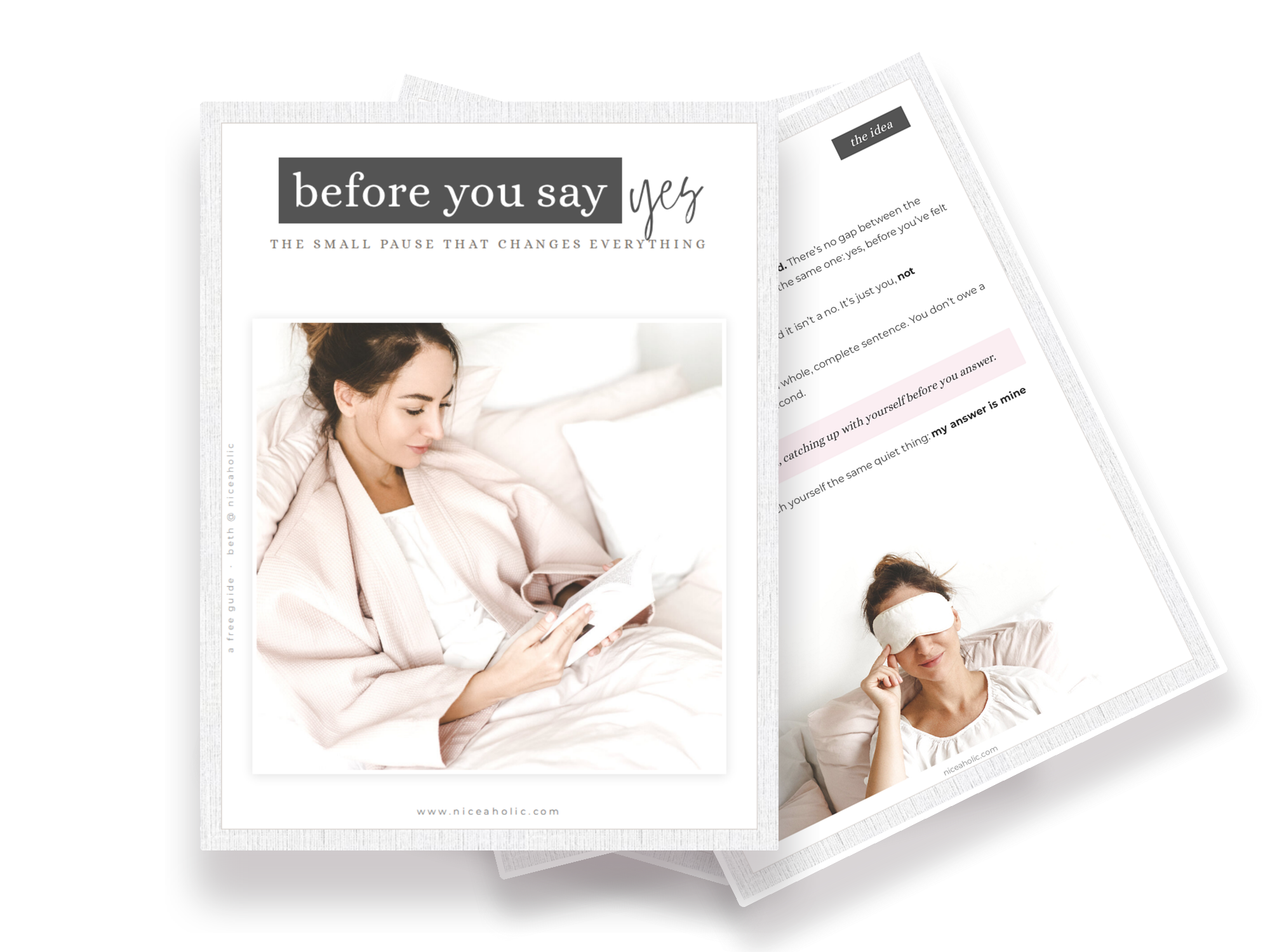
Want a moment to think before the explaining starts?
My free guide, Before You Say Yes, is a short guide to pausing before you answer, with lines to keep. With a moment to think first, one line is much easier to stop at.
Send me the free guideFree. Arrives by email.One day soon you'll send a one-line no, set the phone down and feel the knot in your stomach let go. And your Saturday is still all yours.

This is general information, not therapy. If you're ever frightened for your safety, please contact your local emergency services.